

How To Make A Porch Swing Bed
How to Build a Porch Swing
Updated: Sep. 28, 2022
Boot back and relax with this fun-to-build weekend project with porch swing plans.

Enjoy the gentle sway of a porch swing on a summer dark. With these articulate how-to instructions and photos, y'all can build a classic porch swing in a weekend.
You might also like: TBD
- Time
- Complexity
- Cost
- Multiple Days
- Intermediate
- $101–250
Swing Design
The smoothen, gentle glide of this porch swing will keep yous daydreaming for hours. In fact, you may lose your ambition for practiced!
The swing's elementary cuts and no-hassle gum and spiral assembly techniques make it a keen first-time woodworking project. You lot tin can build it in a weekend for a few hundred dollars.
We designed the swing with a unique suspension system made from ordinary half inch blackness steel pipe (normally used for gas piping) slipped through the swing frame to act as a cradle and eliminate stress on wood joints. Center bolts are then fastened through the steel pipe and covered by soft safety caps to prevent scrapes. The swing assembly is and so supported with welded steel concatenation, securely fastened to solid framing in the porch roof.
While your work ethic is still intact, round up the post-obit tools: a circular saw, drill with bits and screwdriver attachment, jigsaw, tape measure, square, pencil, power sander, hacksaw and an adaptable wrench. You'll also need admission to a table saw.
If you're a first-timer, be aware that you'll need to pre-drill holes for every screw so you don't split the wood or bust the screw shaft. To make this procedure easier, purchase a special countersink bit that can do both in one performance and has a driver on the opposite end.
Circumspection!
Swings are inherently unsafe for small children. This swing moves slowly, but it has hard edges that can give a nasty crash-land. Kids will love this swing, but never allow minor children play effectually information technology unattended.
Pick Knot Free Boards and Measure Carefully

Photo 1: Rip the supports
Gear up your saw at 27-one/2 degrees and rip the pieces that make the center and elevation dorsum supports. If you don't accept a table saw, ask the lumberyard or a well-equipped neighbor to aid.

Photo 2: Cut the curved pieces
Clench the seat back up parts to the workbench to keep them from wandering while y'all cut the curves. Follow the pattern in Fig. A to accurately copy the curves for the seat frames as well every bit the artillery. Sand forth the curves after cut.
Knots can weaken a board and spell disaster, especially on furniture. Too, stay away from cedar, redwood and soft pine for this project. They'll mar easily and won't hold screws as well every bit other, denser forest. Fantabulous wood choices are fir, Southern yellow pino, cypress, poplar, white oak and maple. Oak and maple are harder to cut, sand, drill and screw, so if you're a first-timer, avert them. We chose poplar considering information technology's potent, readily bachelor, easy to piece of work and takes paint well.
Cut all the parts to the dimensions in the Cutting List (see Additional Information, below). Using a table saw, make 1x3s from your 1x6s (see Cut List). Then notch the front arm supports equally shown in Fig. A. Describe the curved shapes (parts A and P) onto hardboard as shown in Photo 2 and trace them onto boards, or merely draw the one inch square grids directly onto the pieces. Cutting them out with your jigsaw and sand the curves smooth with 100-grit sandpaper. Drill seven-eighths inch diameter holes with a sharp spade bit into parts A for the forepart pipe hanger.
Cut the middle and height horizontal back braces (parts F and Grand) from 1x4s as shown in Photo i. A table saw works all-time. If yous're an ace with a circular saw, you tin can prepare your saw bevel, tack the 1×4 to the tops of your sawhorses to proceed the board from moving, and so saw forth a line right down the length of the board. Next, mark a diagonal taper onto a 1×3 equally shown in Fig. A to brand the two outer slats (G) from this single piece. Cut along the line with your jigsaw, then apply a block airplane to smooth the cutting edge. Gear up the seat assembly aside.
Figure A: Gratis Porch Swing Plans
This cutaway drawing shows the structure details for the porch swing. To download a larger PDF version of these gratuitous porch swing plans, see Additional Information. The complete Cutting List and Shopping List are besides in Additional Information.
Assemble The Swing on a Temporary Workbench

Photo 3: Assemble the front arm supports
Notch the front arm supports with a jigsaw to accept the front stringer (C). Drill pilot and countersink holes and apply a dab of construction agglutinative at each articulation. Fasten with 1-5/8 in. deck screws.

Photo 4: Attach the rear stringer
Trace the bending of the heart seat caryatid (A2) onto each side brace to get the proper positioning of the rear stringer (D) fastening points. Once more, drill pilot holes and glue and spiral the seat braces to the front end stringer and the front arm braces. Next, glue and screw the rear stringer to the seat braces.

Photograph 5: Fasten the back slats
Lay all the back slats face downwardly on a apartment surface and slip temporary one-quarter inch spacers between the slats. Spike the bottom brace (E) to the centre slat, using a framing square to make sure they're joined at 90 degrees.

Photo 6: Cut the height curves
Trace the height curves on the forepart side of the back assembly using a simple homemade beam compass. Blast one terminate of the compass 14 inches from the elevation and in the eye of the 1×6 back slat. Insert your pencil into the one-quarter inch hole drilled in the other stop of the compass. Cutting along the mark with your jigsaw.

Photo seven: Join the back and seat assemblies
Hang the lower function of the back assembly over the border of the work surface to make room as you lot slide the seat assembly onto it. Align the rear stringer of the seat associates with a marking drawn two-1/2 in. from the bottom of the back associates. Mucilage the joint, then clamp and screw the assemblies together.
Create a large work surface past laying a sheet of plywood across sawhorses (Photograph vii). Mucilage and screw the front stringer (C) to the front arm braces (B). Side by side, fasten this assembly to the seat braces (A1 and A2) and rear stringer (D) to complete the seat frame assembly (Photograph iv). Drill through the front arm braces (B) with your 7-eighths inch drill bit subsequently y'all've glued and screwed the side seat braces to them (Photo 4). These ii holes will complete the pathway for the front pipage support (Q).
Afterward y'all assemble the arm braces, stringers and seat braces, glue and screw the curved forepart arm supports (L) to the sides of B every bit shown in Fig. A.
Assemble the dorsum as shown in Fig. A and Photo 5. Cut 1-quarter inch spacers from flake wood (one-quarter inch plywood pieces are perfect) to help maintain consequent spacing.
Start at the center and work out to the sides. When you get to the quaternary slat on each side, check your spacing; you may need to accommodate information technology so the outer edge of the tapered slat (Thousand) is flush with the cease of the lower back brace (E).
Now it'southward fourth dimension to cut the curves on the dorsum assembly. Make a simple beam compass from a scrap of forest every bit shown in Photo 6. Flip the backrest assembly over, utilize your beam compass to mark the curves and cut along the mark with a jigsaw. With the backrest assembly in this position, measure and mark a ii-1/2 in. line parallel to the lesser border (Photo seven).
Grab the seat frame assembly yous congenital earlier and finesse it onto the backrest assembly (Photograph 7). It's crucial to marshal the rear seat frame stringer (D) to the 2-ane/2 in. line on the backrest so the rest of the assembly will fit together.
Drill seven-eighth inch holes in the horizontal arm supports (G) to the verbal dimensions shown in Fig. A. And then glue and screw these pieces to the front end arm braces (B) and the center back brace (F; Photo viii). Next, mucilage and screw the seat slats to the seat braces. Outset in the back and leave approximately a three-sixteenths of an inch space between each piece. Trim the last slat to overhang the front stringer half inch. Plane the transition piece on the bend of the seat (Photograph 10) and at the leading edge of the front seat slat for maximum condolement.
Why Structure Adhesive?
Purchase a small tube of structure adhesive for this outdoor project. Be sure to buy the heavy-duty type for exterior use. Structure adhesive will help your porch swing stand up to both weather condition and stress. The modest tube shown is the aforementioned stuff as in the larger "caulk-gun" sized tubes simply is less cumbersome for a smaller project like the swing. Apply a modest bead at every joint. If the glue oozes slightly, let the backlog harden and then scrape it off with a precipitous putty knife or wood chisel.
Don't Skimp on the Hardware

Photo 8: Fit the pipes
Cut and drill the pipes (Fig. A) and slide them into the holes. File the inside of the vii-eighths inch hole in the arm support (M) with a coarse half-round file if the support pipage won't easily slide through. The rear support piping should fit snugly under the middle dorsum brace (F) as it protrudes through each arm support.

Photo ix: Add together screws for stops
Drill a three-sixteenths inch hole in the centre of the rear support pipe, then screw a 2 inch No. 8 sheet metallic screw (use a 1-eighth inch pilot hole) upwards into the center dorsum back up. This connection volition keep the pipage from sliding to one side while the swing is swinging.
Purchase oversize (three-sixteenth inch or one-quarter inch thick) chain with welded links for good looks and rubber. As well buy one-quarter inch threaded eyebolts forth with thread-locking compound to go along the nuts from working loose. The quick-link optics (Photo 11) are indispensable for linking concatenation quickly. Buy your black pipage at a hardware store and take it cutting to verbal lengths without threaded ends.
At present, examination-fit the piping, chain and connecting links to the wooden assembly (Fig. A). Information technology's a good time to discover any glitches and correct them before you paint. Slide the pipes through the holes in the seat frame and forth the dorsum, leaving an equal amount exposed on each side. Mark the pigsty locations in the pipes to lock them to the swing (Photo 9 and Fig. A). Drill iii-sixteenth inch diameter holes for the sheet metal lockscrews and ix/32-in. bore screws for the eye bolts. Angle the eye bolts slightly toward the center of the swing to minimize the torque on the pipe and prevent the lockscrews from breaking.
Retrieve, this swing could exist holding 400 lbs. or more than, and so you must anchor the swing's chain with one-half inch shaft spiral optics screwed at least two inches into solid framing as shown in Fig. C. Also, distribute the weight to more than than i ceiling joist by screwing a pair of 2x4s 54 inches apart and then inserting the screw optics into the 2x4s.
Effigy B: Porch Swing End View
To download a larger PDF version of Figure B and the rest of these heavy duty porch swing plans, see Boosted Information, below. The complete Cutting List and Shopping Listing are also in Additional Data.
Ease the Wood Edges Before You lot Paint

Photo 10: Even out high spots
Shave off any high spots in the seat slats with a block plane. Because the seat is curved, the slat edges can ride loftier at certain points, making for a less-than-comfortable ride later.

Ease the edges
A block plane is the quickest manner to ease sharp edges and high spots.
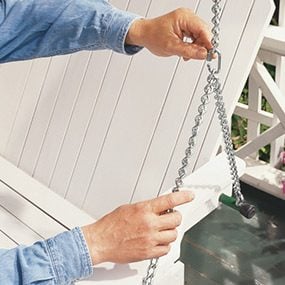
Photo 11: Hang the swing
Hang the swing securely using special quick-link optics to join the lengths of chain. The swing should tip dorsum slightly at the arms (well-nigh one inch from back to front) when the swing is at rest.
Remove the chains and pipes to paint the wood associates. Sand the pipes with 100-grit sandpaper, and so wipe them downwards with a rag dampened with mineral spirits. Allow the mineral spirits evaporate off the surfaces, so spray-pigment the pipes with outside primer followed by an outside enamel.
Sand the wood parts with 100-grit sandpaper, paying particular attention to the arms and the edges of the seat and back. Softer edges volition be safer and more comfortable and hold paint better.
Wipe off the dust and vacuum the swing. You'll make better fourth dimension if you gyre (use a small-scale four inch roller) on a expert-quality primer and follow it up with a brush to even the coat. Use the brush to paint betwixt the slats and then look for runs and drips coming through the other side. Use oil-based primer (or h2o-based if y'all adopt), then lightly sand the swing the next day with 150-grit sandpaper. Choose the all-time polyurethane outside paint you lot can find and utilize it using the same roller and brush technique. Let the pigment cure for a couple of days earlier y'all rehang the swing. Note: During the final assembly, squirt thread-locking compound on the centre bolt threads. Be sure to cut the eye bolts flush with the nuts for safety.
Effigy C: Hanging Item
Screw a length of 2×four into solid framing to support each concatenation. Exist certain to use four inch long lag screws and bridge at least three ceiling joists. (See Additional Information for a printable PDF version of Effigy C.)
Free porch swing plans: Project PDF Files
Click the links below to download the structure drawings, materials listing, cutting listing and complimentary porch swing plans for this project.
Cutting and Materials Lists and Structure Drawings
Additional Information and Porch Swing Plans
- Figure C: Hanging Detail
- Shopping List
- Figure A: Porch Swing Details
- Effigy B: Porch Swing Terminate View
- Cutting List
Required Tools for this Project
Have the necessary tools for this DIY project lined up before you start — you'll relieve fourth dimension and frustration.
Originally Published: Apr 10, 2020
Source: https://www.familyhandyman.com/project/build-a-porch-swing/
0 Response to "How To Make A Porch Swing Bed"
Post a Comment